Orbital ADR: Autonomous Space Debris Cleaning Robot
Active Debris Removal (ADR) & Orbital Logistics Platform (Smart India Hackathon 2026 — PS SIH26226)
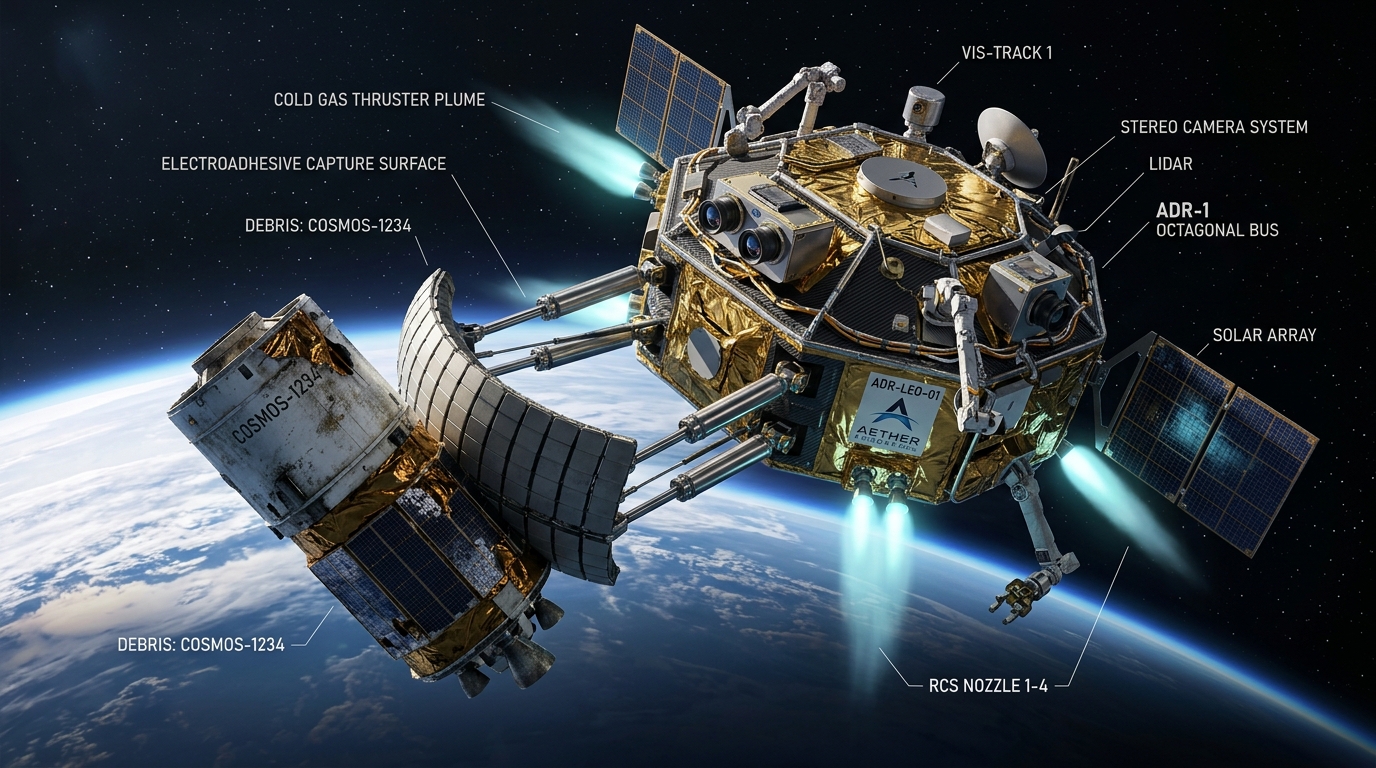
Autonomous LEO Space Debris Cleaner — SIH 2026 Presentation
SYSTEM ARCHITECTURE & ACTIVE DEBRIS REMOVAL (ADR)
Engineered an autonomous Active Debris Removal (ADR) spacecraft architecture designed for Low Earth Orbit (LEO) debris remediation under SIH Problem Statement SIH26226. Combines a custom octagonal CAD bus with a 4-piston mechanical Compression System to dampen docking kinetics, alongside an electroadhesive capture plate capable of gripping non-conductive, irregular space debris. Uses a segregated dual-compute architecture: NVIDIA Jetson Nano running ROS 2 and SpaceYOLO for non-cooperative tumbling target pose estimation, linked to an STM32 MCU for microsecond cold-gas thruster firings, backed by a live Three.js orbital mission control interface.
Vision-guided autonomous proximity operations and attitude synchronization matching the rotational axes of tumbling, non-cooperative orbital debris targets.
Deploys dedicated solid-rocket braking booster modules onto massive defunct satellites to execute safe atmospheric reentry burns without depleting the mothership's main Δv reserves.
Serves as an enduring in-orbit logistics and positioning platform capable of station-keeping, orbital transfer, and commercial space station module berthing.
ELECTROADHESION & 4-PISTON KINETIC DAMPING
Capturing uncooperative space debris presents two fundamental mechanical challenges: docking collision kinetics and non-magnetic material compositions. This architecture overcomes both through integrated mechanical and electrodynamic design:
Quad mechanical shock-absorbing compression pistons absorb kinetic impact energy during high-mass debris contact, stabilizing the chaser bus and eliminating rebound oscillations.
Uses high-voltage, low-current electrostatic polarization to generate compliant clamping force across non-conductive carbon fiber composites, solar panel glass, and painted satellite hulls.
SEGREGATED DUAL-COMPUTE EMBEDDED HIERARCHY
Mission safety in microgravity requires strict compute segregation between heavy neural vision pipelines and time-critical reaction control thruster actuation:
- High-Level Compute (NVIDIA Jetson Nano): Ingests dual stereo camera frames to run SpaceYOLO and OpenCV feature extraction, estimating relative 6-DOF pose vectors and rotation velocity vectors of tumbling targets in real-time.
- Low-Level Real-Time Controller (STM32): Executes deterministic, microsecond-accurate cold-gas Reaction Control System (RCS) pulse-width firings to maintain precise orbital station-keeping within millimeter tolerances.
- Telemetry Downlink (FastAPI + WebSockets): Streams live orbital coordinates, capture plate status, and attitude matrices into a real-time Three.js WebGL mission control console at sih-space-tech.deepak-arkz.me.
TECHNICAL HIGHLIGHTS & MISSION READINESS
- Designed 3-phase orbital flight plan: autonomous chaser rendezvous, mothership deployable deorbit braking modules, and reusable orbital tug logistics.
- Bypassed traditional magnetic grapple limitations using high-voltage electroadhesion to adhere to carbon fiber, composite casings, and glass.
- Deployed an interactive WebGL mission control simulator providing real-time 3D telemetry and docking trajectory visualization.